Posts

Showing posts with the label midrash

Even Izevel had some Good in Her

I just came across this wonderous midrash. The midrash came to explain why Izevel (Jezebel)'s skull, feet and palms remained after her corpse was devoured by dogs ( Melachim 2:9:35 ). According to the midrash, which appears in multiple sources, including Pirkei De'Rabbi Eliezer and Yalkut Shimoni , "Whence do we learn (the duty of) showing loving-kindness to mourners? From Jezebel, the daughter of Ethbaal. The palace of Jezebel, daughter of Ethbaal, was near the market-place. When any corpse was carried through the market-place, she would go forth from her palace, and she clapped with the palms of her hands and praised with her mouth, and she followed the corpse ten steps. Concerning her, Elijah, be he remembered for good, prophesied (and said): "In the portion of Jezreel shall the dogs eat the flesh of Jezebel" (2 Kings 9:36). But over the limbs which were (employed in) showing loving-kindness, the dogs had no power, as it is said, "And they went || to bur...

Efron and Chevron

A strange thought passed through my mind during kriat ha'Torah today: What if Chevron was named after Efron? Explanation: The Hebrew letters Ayin (ע) and Chet (ח) sometimes get mixed up in variant Semitic dialects, including Hebrew and Aramaic. So, for example, the midrash notes  that in the Galilee people pronounced the proper noun Chivim ( ח ויא, Hivites) as Ivim ( ע ויא, Ivites)  (this midrash is originally in Beresheet Rabbah, however the version brought in Sefaria is distorted and has אויא with an Alef instead of עויא) . Similarly, the letters Peh (פ) and Bet (ב) also get mixed up. For example, in Bavli Shabbat 57b a braita is quoted, where it says that a woman may go out with a ס ב כה (hairnet) on Shabbat. However, in the parallel Tosefta, it says a woman may go out with a ס פ כה ( link ). And there are many other examples for both, and from different time periods. So, if we change the letters Ayin and Peh (well, Pheh in this case) in Efron (עפרון) with Chet and Bet (Ve...

Yaakov and Lavan's treaty through the ages

Image
May this post be a merit for the success of our soldiers and the safe return of all of the hostages that are still alive, and the bodies of the deceased, and a refuah shlemah for Dror Yisrael ben Rut Miriam (דרור ישראל בן רות מרים). As a friend of mine pointed out earlier today, it's somewhat ironic that on the week where we read of Yaakov and Lavan's treaty, Israel is signing a treaty with Hamas (ימ"ש). An interesting midrash notes that the treaty was still valid many centuries later: Midrash Tanchuma Devarim 3:1 "...מכתם זה דוד, שעשה עצמו מך, ותם על שהלך בתמימות עם קונו, אימתי בהצותו את ארם נהרים, מהון כשהלך יואב להלחם עם ארם נהרים, יצאו לקראתו, אמרו לו אתה מבני בניו של יעקב, ואנו מבני בניו של לבן, והרי תנאי שלהם [קיים], דכתיב עד הגל הזה (בראשית לא נב) , כששמע יואב חזר אצל דוד, א"ל מה אתה אומר הרי תנאו שבועת יעקב אבינו, מיד הושיבו סנהדרין שושן עדות, [ללמד] למדוהו ואמרו באמת כך היה, אלא הם עברוהו תחילה, בלעם הרשע מפני מה עבר, לא כך אמר מן ארם ינחני בלק מלך מוא...

The Girgeshites

Long time no see... Life has been incredibly busy and is still a bit busy, but at least I have time for making a post on occasion. Here's an interesting thought about the Girgeshites. The Girgeshites (הגרגשי) were one of the seven Canaanite nations. According to Yerushalmi Sheviit 6:1 : "For Rebbi Samuel bar Naḥman said, Joshua sent three orders to the Land of Israel before they entered the Land: Those who want to evacuate should evacuate, those who want to make peace should make peace, those who want to go to war should go to war. The Girgasites evacuated, believed in the Holy One, praised be He, and went to Africa." Famously, Procopius also brought a version of this tradition in his work The History of Wars, IV : " In that country there dwelt very populous tribes, the Gergesites and the Jebusites and some others with other names by which they are called in the history of the Hebrews.  Now when these nations saw that the invading general was an irresistible prodigy...

The Blasphemer - It's Complicated

I considered writing another post about the blasphemer, a subject near and dear to my heart (because it's an unsolved mystery!), but then I discovered to my shock that my last post on the subject was actually still in draft mode, never published..! So, though I'm still super busy, here's a ready-made post from last year, touched up and completed: The blasphemer is a subject that has been on and off of my mind for a couple of years now. The blasphemer was the son of Shlomit bat Divri, a woman of the Tribe of Dan, and an Egyptian man, who lived during the time of the Exodus. He had an argument with a purely-Israelite man and ended up cursing God, hence his title as "the blasphemer". He was put to death. The midrash ( Sifra 14:1 ) attempts to explain this story thus: "("And the son of an Israelite woman went out; and he was the son of an Egyptian man in the midst of the children of Israel. And they strove within the camp, the son of the Israelite woman and ...

Shushan Purim Isru Chag Post

Image
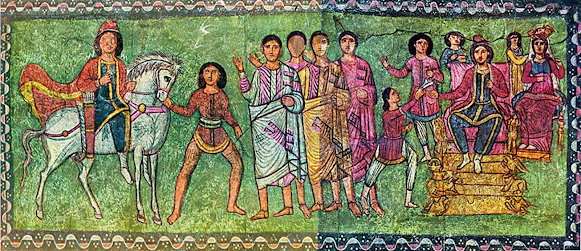
I was going to post this yesterday, but I'm swamped with work...let's just call this the Shushan Purim Isru Chag post...😁 For those who don't know, Dura Europos, a city in eastern Syria, was excavated in the 1930's. One of the most incredible discoveries made there was a well-preserved shul . The shul's walls were decorated with beautiful paintings of scenes from Tanach, such as Eliyahu at Mt. Carmel, the Plishtim being punished for taking the Ark, King David, the First Temple and so forth. One of the most fascinating things about these paintings - which are dated to the years 244-245 CE - is that some of them are based on midrashim. For example, the Eliyahu at Mt. Carmel painting clearly shows Chiel Beit Ha'eli hiding in the Baalic altar and being killed by a snake (alluded to in  Shemot Rabbah 15:16  and  Pesikta Rabbati 4 ; stated explicitly in  Yalkut Shimoni on Nach 214 ). With regards to Purim, there's an honest-to-goodness Purim panel at that shul: ...

An interesting idea on Noach's fig saplings

This is an interesting idea I came across some time last year: In Beresheet Rabbah 36:3 it says: "Instead " To plant a vineyard "; from where did he acquire it? Rabbi Abba son of Kahana said: "He gathered to him planting vine shoots and saplings of figs, and cuttings of olives" The grapevine were taken to make wine, and it seems to me pretty obvious that Noach wanted to drown out his sorrows with wine, and knew he would need this ahead of time. But why fig saplings? Rabbi Yishai Zargeri wrote in his book Bigdei Yesha (בגדי ישע), pp . 67-68 (my translation): "And it seems to me that the explanation is that we find that Noach prepared sacrifices when he exited the ark, and to light the fire he needed wood, and since all of the trees were soaked with water it wasn't relevant to light the fire from them, and so Noach needed to bring with him trees into the ark. And it says in the mishna in masechet Tamid ( p. 29a ) that wood from all the trees were fit fo...

Irad, Iram and other Ir names

Been a little while since I've made a post on name-meanings, but I had this realization recently. For some time this last semester, I had been looking into the topic of apocryphal Enochic literature, because I had been thinking about doing a project on it for one of my courses. Eventually I switched to a different topic (if you're curious, it's about the Nesiut (patriarchy) of Rabban Yochanan ben Zakkai) , but having already delved pretty deeply into the subject, I realized recently that the topic might serve to explain the meaning of two ancient Tanachic names. I say ancient because chronologically-speaking, these people are some of the oldest in Tanach. Irad: Irad was none other than Kayin (Cain)'s grandson, son of his son Chanoch (the first, less-famous Enoch): "וַיִּוָּלֵד לַחֲנוֹךְ אֶת  עִירָד   וְעִירָד  יָלַד אֶת מְחוּיָאֵל וּמְחִיָּיאֵל יָלַד אֶת מְתוּשָׁאֵל וּמְתוּשָׁאֵל יָלַד אֶת לָמֶךְ." "To Enoch was born Irad, and Irad begot Mehujael, and Meh...

Anakim, Rephaim, oh my!

This week's parsha features Bnei Yisrael passing through Edom and the two Emorite countries - Sichon's country and Og's country ( Bamidbar 21:21-35 ). Og was the last of the Rephaim ( Devarim 3:11 ), a race of giants that were wiped out way back during the War of the Four and Five Kings in Beresheet ( 14:5 ). Some midrashim state that Sichon was also a giant, of the antediluvian kind (for example, Devarim Rabbah 11:10 ). Looking through Tanach it occurred to me that giants might be frightening, but they obviously aren't unbeatable. David and his men defeated a number of giants, and, as mentioned already, the four Mesopotamian kings managed to defeat the Rephaim. And yet, two parshas ago, when the spies told Bnei Yisrael that there were Anakim in the Land of Yisrael ( Bamidbar 13:28 ), Kalev and Yehoshua said nothing about "hey, guys, giants are not unbeatable!" Kalev made a more generalized statement, that "yes we can, because we have Hashem!" ( ibid...

Tiglat-Pileser I: On the road to re-unifying Am Yisrael?!

This post title is based on this post title because the subjects are similar. I read a very interesting essay on Shabbat by Yitzchak Avishur . It's titled (in Hebrew) "Literary Inventions and Historiographical Descriptions in Chronicles 1:5 - Which Tiglath Pileser Exiled Be'erah the Reubenite Prince?" As you can already guess from the post title, the answer to the essay's title's question is Tiglat Pileser I , who lived around the year 1100 BCE. Avishur examines the different events described in Chronicles 1:5 and points out that it would be illogical to think that the verse "his son Beerah—whom King Tillegath-pilneser of Assyria exiled—was chieftain of the Reubenites" ( ibid. 6 ) refers to the same event described in the verse "So the God of Israel roused the spirit of King Pul of Assyria—the spirit of King Tillegath-pilneser of Assyria—and he carried them away, namely, the Reubenites, the Gadites, and the half-tribe of Manasseh, and brought t...

Two suggested answers for Rashi's question on Shemot 14:7

Image
Yes, the title is a misnomer. The question was originally asked by the Mechilta on the verse . And that question is as follows: ""And he took six hundred choice chariots" ( 14:7 ): Whence came the horses required for the chariots? If you would say, from Egypt, is it not written (Ibid. 9:6) "and all the cattle of Egypt died"? And if you would say, from Pharaoh, is it not written (Ibid. 3) "Behold, the hand of the Lord is in your cattle in the field, in the horses, etc."? And if you say, from Israel, is it not written (Ibid. 10:26) "And our cattle, too, will go with us; not a hoof will remain"? Whence, then, did they come?" Now, the Mechilta goes on to explain that the horses belonged to those Egyptians who feared Hashem and listened to Moshe's warnings during the plagues that killed the domesticated animals. But earlier this evening I thought of two other possibilities: 1. The midrash in Shemot Rabbah 10:2 says (loose translation): ...

The importance of Chazalic drashic interpretations

 A quick thought I had last night, before getting on to part 2 of the Barak/Devorah posts: I've been troubled in recent months as I realized that I was moving away from my old comfort zone of favoring both P'shat and Drash in understanding Tanach, and moving towards almost an entirely P'shat mentality, grounded in archeological findings and word etymologies, among other things. I was bothered by this because it felt like I was beginning to see the aRDeS part of PaRDeS (P'shat, Remez, Drash and Sod) as meaningless, which I know it's not. But in a sense, it felt like I no longer saw any point in these aspects. Well, I'm still making my through this forest, but I wanted to share a thought I had last night: I was listening to a class on the story of Palti ben Laish and Michal. The question is an oldy: How could Palti marry a married woman (it doesn't say that David divorced Michal) and how could David take back Michal, after all, a man cannot take back his wife ...

The blog banner

Image
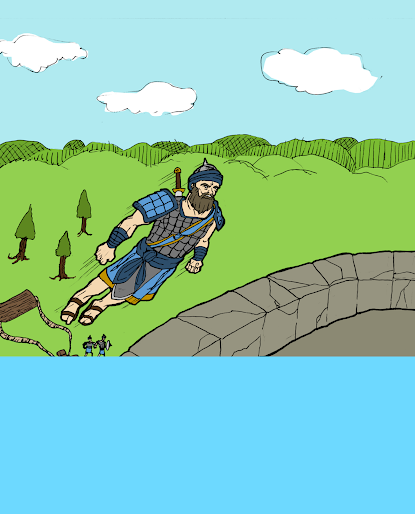
 I always planned to make this post but never got around to it. What's the deal with the blog's banner? (image taken from my files. Copyright me) Well, first of all, what are we seeing here, and what does that have to do with Tanach? Okay, so this image as related to Tanach is a bit of a cheat because it's based on a midrash. The midrash, which exists in a few versions ( here 's one from Otzar Hamidrashim), describes Yoav ben Tz'ruyah, King David's general, going off with an army to battle the Amalekites in their state (or city-state?) of Kinsli. After six months of siege, the men get tired and want to leave. Yoav decides to launch himself over the city walls and figure out a way to unlock the gates and let his men in. He does this, and eventually manages to get his men in and they defeat the Amalekites. Fast-forward a few thousand years later, and it's Inktober of Elul-Tishrei 5779-5780 and I decided I would try the challenge (after not having done it sinc...

Elkanah: On the road towards re-unifying Am Yisrael

 Recently I got into writing short stories about very very minor side-characters in Tanach. I call it "Tanachic fanfiction". Interestingly, I've found that during plotting and writing, I actually think of some interesting chiddushim that could actually be plausible. One was a recent thought about Elkanah, father of Shmuel. It is very noticeable that during the time of the Shoftim, Am Yisrael were not united. From the civil war between Yisrael and Binyamin, including Yavesh Gilad having pulled a Switzerland and opting out of the war (which led to their doom), through the Efraim and Menashe civil war in the time of Yiftach, through tribes that did not join Barak and Devorah in their battle against the Canaanites, and these are just some of the most significant examples. There are many more, both explicit and implicit. A few weeks ago I heard a class by Dr. Chagai Misgav about the religious lives of Yisrael in the time of the Shoftim. He pointed out that leadership at the t...