Posts

Showing posts with the label archeology

First published Tanach paper!

I'm happy to share that my first Tanach paper has been published and is now available online: Hoham, King of Hebron, Jewish Bible Quarterly 53:2 (2025), pp. 87-96. It can be found both on the issue's webpage and on academia.edu .

Jericho or Qericho?

Image
Last night I read a fairly new article by Lorenzo Nigro, whom I gathered directs the Rome La Sapienza University excavation project in Tel es-Sultan (biblical Jericho). I've been vaguely familiar of his work since I tore through Iron Age publications last year trying to find mentions of LMLK stamped handles for a uni project. He was also part of a project in Beit Lechem, as well as other projects in Judea and Samaria. One important thing to note is that all of these projects were undertaken together with the "Palestinian" Ministry of Heritage. The article I'm talking about summarized findings from the 2019-2023 season at Jericho. I was quite surprised to see identifications of many sub-strata, perhaps more than I'd ever seen in an excavation report (Early Bronze IVa and IVb? Who ever heard of splitting the Intermediate Bronze in two?). I skimmed the Bronze Age discussions, though. I'm usually more interested in the Iron Age findings. There I received quite a ...

Megadim 63 is finally here!

Image
Happy to update that Megadim volume 63, dedicated to one of the founders of the journal, Rabbi Yoel Bin Nun, has finally been published and uploaded to the journal's section on the Herzog College website. You can find it here . The journal includes the long-anticipated paper by Gershon Galil and Eli Shukron summarizing some of their new research on inscriptions they associate with King Chizkiyahu. This paper is a reworking of one chapter of their still-anticipated book on the inscriptions, due to come out some time in the near future. Other papers that off the bat look interesting to me (though, knowing myself, boredom and lack of reading material will probably lead me to read most of the rest and discover that others are interesting as well): A paper by Rabbi Prof. Yoel Elitzur on the mentioning of Chiel's building of the wall of Yericho. A paper by Dr. Neriah Klein on Sefer Melachim as a historical reconstruction of biblical history from Beresheet to Shoftim. A paper by Dr. Y...

Things with Wings

Image
The IAA (Israel Antiquities Authority) publicized today a cool seal from the time of the First Temple recently found near Wilson's Arch in Yerushalayim. The seal features an Assyrian-style winged figure and the name of one Yehoezer ben Hoshayahu. (the newly-discovered seal; image taken from here ) The figure on the seal is usually interpreted as a "daemon" or "genius", a kind of mythological guardian figure from Assyria. This is far from the first time mythological figures and creatures have been found on Israelite and Judahite seals and bullae. In fact, even King Chizkiyahu (Hezekiah)'s bullae feature a variety of Egyptian mythological entities, including a scarab, a winged sun disk, and an Egyptian-style winged figure. (Chizkiyahu bulla w/ winged sun disk and ankhs from Elat Mazar's Ophel Excavations) (Chizkiyahu bulla w/ scarab from private collection) (Chizkiyahu bulla w/ winged figure and ankh symbol from private collection) I'm sure that some p...

Even More Egyptian Influences on the Tribe of Yehudah (pt. 4)

This is part 4 of a series of posts I made shortly after starting the blog (nos. 1 , 2 , 3 ). Back then, I noticed that there were many ties between the Tribe of Yehudah in particular and Egypt. This was most particularly apparent in their personal names, though there were a couple of other connections. I am now in the midst of conducting research for my latest seminar paper, in which I will attempt to propose a link between the Samaria Ostraca and the LMLK handles (more on that in a later post). As researching one fascinating topic goes, my search led me to many other fascinating topics, one being the subject of Egyptian icons in Judahite (i.e., of the Kingdom of Yehudah) material culture. For example, all LMLK handles feature variants of two main Egyptian symbols: A winged disk (many identify it with the Egyptian winged sun disk) or a winged scarab, a sacred Egyptian symbol. Another example are Judahite seals, many of which feature blatant Egyptian symbols, including idolatrous symbo...

Danite Territory, once more

Nearly a year ago I posted about a topic that I had been thinking about, which is the boundaries of the northern territory of Dan, the one they conquered after leaving their original coastal territory. Last Shabbat (yesterday), I started thinking about how mapping out something like this would work, given that the Tanach doesn't give us any explicit information regarding their new territory, save for their central city, Laish/Leshem/Dan. It occurred to me that the next best thing would be to mark the boundaries of all countries and tribal territories around them- and the middle space will be that of Dan. I don't know if it's entirely possible, though. But we could probably mark up well the boundaries of Naftali and the Transjordanian half of Menashe. That would give us Dan's western and southern borders. In the east we have the Aramean petty kingdoms (new term I heard...): Geshur, Tov, Ma'achah, Aram Tzovah, Aram Damascus (I hope I didn't forget anyone). Archeol...

Ba'al Zevuv

Some time ago a friend requested my assistance in tracking down info regarding the idolatrous deity Ba'al Zevuv (Beelzebub). I believe he was interested in modern scholarship on the matter and in particular was hoping there'd be archeological data that would shed light on the mystery. So I rolled up my sleeves and got to work. Spoiler: I didn't find too much, but there are some interesting suggestions out there. Ba'al Zevuv appears in two verses in Melachim 2:1:2-3 : "Ahaziah fell through the lattice in his upper chamber at Samaria and was injured. So he sent messengers, whom he instructed: “Go inquire of Baal-zebub, the god of Ekron, whether I shall recover from this injury.” But an angel of G OD said to Elijah the Tishbite, “Go and confront the messengers of the king of Samaria and say to them, ‘Is there no God in Israel that you go to inquire of Baal-zebub, the god of Ekron?" After which Eliyahu informs Achazyah ( ibid. 4 ): "Assuredly, thus said G OD...

Academic publication of the Mt. Ebal amulet

Prof. Gershon Galil et al have finally published the long-awaited academic publication of the Mt. Ebal amulet . Galil received a lot of heated backlash from the academic world when he first announced last year his reading of the amulet, found during sifting work of the backfill from the 80's excavation of the Mt. Ebal altar in Samaria. Galil hadn't gone through the more acceptable procedure of publishing his research through a peer-reviewed platform. Peer-reviewing has its flaws, but it's also a useful tool for gauging the legitimacy of a person's research. I thought at the time that he must have a good reason for this unorthodox action, and decided to give him the benefit of the doubt. Not long afterwards he announced the discovery of a similar "curse" inscription, dated to Jebusite/Canaanite Yerushalayim. Once again, nothing on when a peer-reviewed publication will come out. And then he announced the discovery of a series of inscriptions which he associated ...

Shushan Purim Isru Chag Post

Image
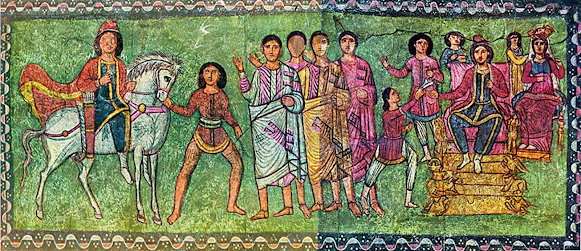
I was going to post this yesterday, but I'm swamped with work...let's just call this the Shushan Purim Isru Chag post...😁 For those who don't know, Dura Europos, a city in eastern Syria, was excavated in the 1930's. One of the most incredible discoveries made there was a well-preserved shul . The shul's walls were decorated with beautiful paintings of scenes from Tanach, such as Eliyahu at Mt. Carmel, the Plishtim being punished for taking the Ark, King David, the First Temple and so forth. One of the most fascinating things about these paintings - which are dated to the years 244-245 CE - is that some of them are based on midrashim. For example, the Eliyahu at Mt. Carmel painting clearly shows Chiel Beit Ha'eli hiding in the Baalic altar and being killed by a snake (alluded to in  Shemot Rabbah 15:16  and  Pesikta Rabbati 4 ; stated explicitly in  Yalkut Shimoni on Nach 214 ). With regards to Purim, there's an honest-to-goodness Purim panel at that shul: ...

Some info on what we found in Tibneh

Image
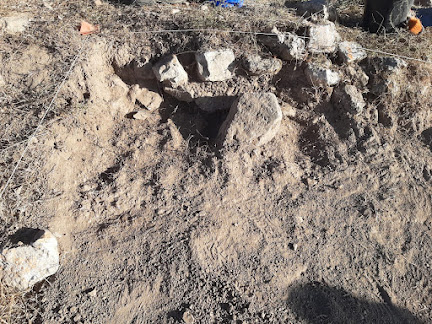
As promised, a post on why I was unable to find time to make the second part of the Shiloh destruction posts for over a month. It was because, as previously mentioned here , I had gone on a month-long excavation in Tel Tibnah/Tibna/Tibneh (however you want to spell), an archeological tel in Southwest Shomron (Samaria). We were quite busy there and between the archeological work and my work as a volunteer translator of our social media posts, as well as occasional breaks, I couldn't find the time to make the post. I thought I would use the following post to discuss some of the Tanachic-era findings from the site. Not everything has been properly studied yet, though, so there's not that much to say right now. The site is identified by pretty much all scholars with the Roman-era regional capital city Timnah. Some scholars also identify it with Timnat Serach or Timnah Cheres, the city of Yehoshua bin Nun. During this first season of excavations, we mostly found Roman and Hellenisti...

Obligatory archeology post

Image
Hey to whomever may read this post and might find this relevant: As you may or may not know, I study archeology in Bar-Ilan University. In a little over a month, we'll be opening up a digging season in a very Tanach-related site called in Arabic Tel Tibneh or Khirbet Tibneh and in Hebrew: Tel Timna . For about 160 years or so, it's been identified with Timnat Serach , AKA Timnat Cheres, which is most famous for being the home of Yehoshua bin Nun. The site has never actually been excavated before, so it's rich in potential. Past surveys of the site have identified Roman-era tombs and a columbarium, as well as a Roman road nearby, now covered by a modern road. One of the tombs has been identified with Yehoshua's tomb. So, if relevant for you and you're interested, we're looking for more volunteers. Here's the ad for the dig: For more info as well as updates, check out the project's Facebook page .

Exodus: The challenge of our generation?

Image
On this blog I've discussed a couple of times the Exodus and archeology (see here and here ). Recently, I have been thinking to myself that perhaps the lack of hard evidence means something. True, there's a loose collection of findings (such as the Ipuwer Papyrus or the Book of Gates (see here )) that many Bible-believers hold to be evidence of the Exodus, but since they have all been dismissed by academic scholars in a manner that has lulled the world into a belief that there is zero evidence for the Exodus, it is difficult to consider them hard evidence. Not impossible, just difficult. Which led me to think that perhaps there's a reason for us not having found hard evidence for the Exodus, i.e., something that will completely knock the socks off of academia, and that is that the Exodus stands as a challenge to our generation: Will you believe or will you deny? Look at it this way: Although we have not yet found evidence for portions of the Tanach, it is no longer (compa...

Ein Ganim and Anem - A Tale of Two (?) Cities

Image
*For those anxiously anticipating the continued adventures of the Danites (not) at sea, that will be B"H a later post, some time.  Besides for exams, I also need to hand in my first academic paper, for my academic writing course. The topic I'm researching is whether the Levitical Cities may have also been border-defense cities. Naturally, part of the research includes attempting to identify the locations of the cities and examining any archeological evidence uncovered so far. Which brings me to the topic of this post: The list of the cities appears in two places: Once in Yehoshua 21 and once in Chronicles 1:6 . The lists are not exactly the same and there are many theories on why this is so, which we won't get into now. My focus in this paper is the cities given by the Tribe of Yissachar. The list in Yehoshua reads :  Kishyon, Dovrat, Yarmut and Ein Ganim, while the list in Chronicles reads : Kadesh, Dovrat, Ramot and Anem. Once again, there are different theories on the ...

Two suggested answers for Rashi's question on Shemot 14:7

Image
Yes, the title is a misnomer. The question was originally asked by the Mechilta on the verse . And that question is as follows: ""And he took six hundred choice chariots" ( 14:7 ): Whence came the horses required for the chariots? If you would say, from Egypt, is it not written (Ibid. 9:6) "and all the cattle of Egypt died"? And if you would say, from Pharaoh, is it not written (Ibid. 3) "Behold, the hand of the Lord is in your cattle in the field, in the horses, etc."? And if you say, from Israel, is it not written (Ibid. 10:26) "And our cattle, too, will go with us; not a hoof will remain"? Whence, then, did they come?" Now, the Mechilta goes on to explain that the horses belonged to those Egyptians who feared Hashem and listened to Moshe's warnings during the plagues that killed the domesticated animals. But earlier this evening I thought of two other possibilities: 1. The midrash in Shemot Rabbah 10:2 says (loose translation): ...

Kinah

Image
 No...this is not a post about that infamous Israeli cootie ...Kinah is a town or city mentioned in Yehoshua 15:22 as being on the border between Yehudah and Edom. Though we did not go to the ruins of the actual town last Thursday, we did go to the ruins of the fortress that guarded the town and also collected toll payments from merchants that travelled the "Spice Road" that passed near Kinah. The fortress is presumed by most to have been built around the time of King Yoshiyahu (end of the Assyrian period), but a doctorate student who came with us said that her doctorate involves, among other things, her hypothesis that the fortress was actually built earlier than that - during the Neo-Assyrian period. Kinah, on the other hand, we know from Tanach, is much older than that. And, get this - it's possible that the name is related to the Kenites who, according to Shoftim 1:16 came out of the City of Dates and settled near Arad (Kinah being near Arad)! In Hebrew - קיני - קינ...