Posts

Showing posts with the label ark of the covenant

Further Thoughts on Efron and Chevron

After my recent post on the titular topic, I noticed that Yehoshua 14:15 explicitly states that Chevron was originally named Kiryat Arba after Arba, father of the three main giants who lived in Chevron (Achiman, Sheshai and Talmai). That means that when Avraham was dealing with Efron in Chevron, it likely still hadn't been renamed! Which of course strengthens my suggestion that Chevron was named after Efron. I would suggest that the variant Chevron, which contains the root Chaver (חבר, friend), was chosen because it symbolized the hand of friendship that Efron had extended Avraham, and naming the city after the former was a way of showing thanks to him for that. I was also reminded of two parallels: Goren Aravnah and Shomron. Goren Aravnah or Goren A rnan (the threshing-floor of Aravnah/Arnan) was some sort of threshing compound on the top of what was to become the Temple Mount in the time of David, originally owned by a Yevusi man named Aravnah (in Shmuel) or Arnan (in Chronicl...
Shushan Purim Isru Chag Post

Image
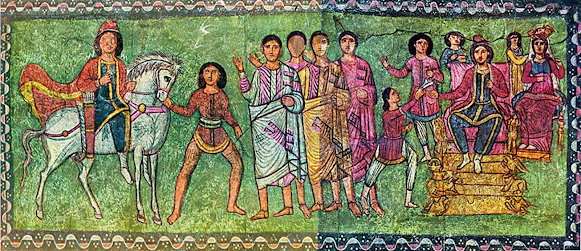
I was going to post this yesterday, but I'm swamped with work...let's just call this the Shushan Purim Isru Chag post...😁 For those who don't know, Dura Europos, a city in eastern Syria, was excavated in the 1930's. One of the most incredible discoveries made there was a well-preserved shul . The shul's walls were decorated with beautiful paintings of scenes from Tanach, such as Eliyahu at Mt. Carmel, the Plishtim being punished for taking the Ark, King David, the First Temple and so forth. One of the most fascinating things about these paintings - which are dated to the years 244-245 CE - is that some of them are based on midrashim. For example, the Eliyahu at Mt. Carmel painting clearly shows Chiel Beit Ha'eli hiding in the Baalic altar and being killed by a snake (alluded to in  Shemot Rabbah 15:16  and  Pesikta Rabbati 4 ; stated explicitly in  Yalkut Shimoni on Nach 214 ). With regards to Purim, there's an honest-to-goodness Purim panel at that shul: ...

The "Rod & Manna" Coins - the History of a Numismatic Interpretation

Image
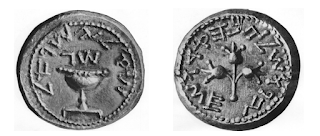
Time for something a little different. Last Shabbat's parasha was Beshalach, which included the introduction of the manna (מן - man). According to Shemot 16:33-34 , Moshe told Aharon to take a jar of sorts (the modern Hebrew צנצנת (tzintzenet) refers to a glass jar, but Rashi interprets  it to mean the more likely pottery vessel of sorts), fill it with manna and place it somewhere for safekeeping. This was eventually put into the Ark of the Covenant for all time. Fast-forward thousands of years later: Ramban (Nachmanides), having narrowly escaped from the clutches of the Church of Aragon after having utterly crushed the Dominican Friar Pablo Christiani in the infamous Disputation of Barcelona , disembarks from a ship at the port of Akko (Acre) in the Land of Israel and settles down there, before passing away some three years later. While there, he sends letters to friends, family and acquaintances in Europe. One of the letters was particularly famous as it was mentioned by a number...

The hidden meaning of Arvanah's name

Image
Shanah Tovah to everyone and have an easy fast. A quick realization that I came to shortly before Mincha yesterday: In Shmuel 2:24:18 , David was commanded to build an altar in a place in Yerushalayim called 'Goren Arvanah ha'Yevusi (The Threshing Floor of Araunah the Jebusite)'. Since it was owned by Arvanah, David it bought it from him and built the altar. This story is also recounted in greater detail in Chronicles 1:21:18-28 . Here Arvanah is called 'Ornan'. Subsequently , David decides that the Temple should be built there, and that project was completed by his son Shlomo ( ibid. 2:3:1 ). In other words, this place would become the final dwelling place of the Ark of the Covenant. Now here's what's really fascinating: The name Arvanah, as it's spelled in Shmuel - ארונה - is made up of the word ארון and the letter ה = the word 'Ark' and the letter Heh, one of the letters of the name of Hashem. I.e., the name Arvanah equals Aron H' ('אר...

Musings about the Ark of the Covenant

Image
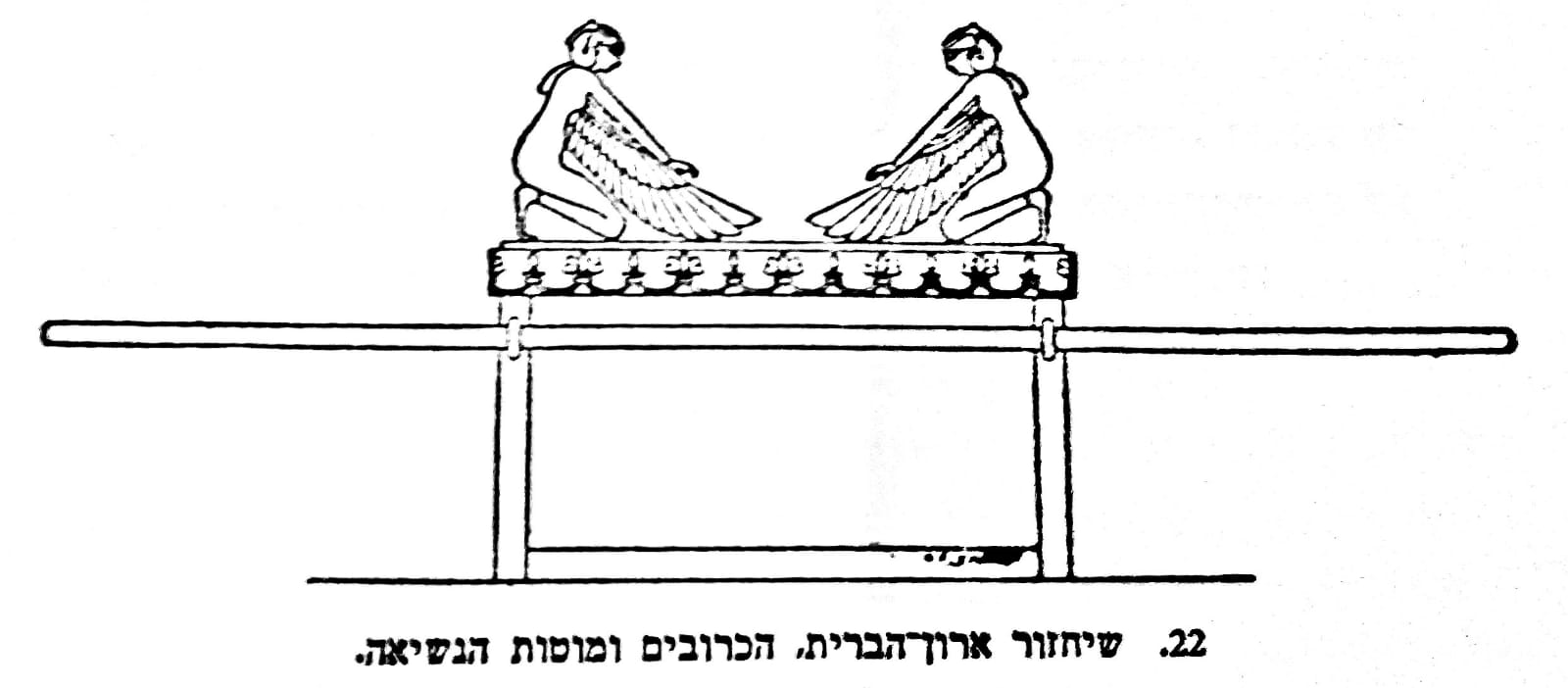
 On the first night of Rosh Hashanah 5781, a friend who shares my fascination with Tanach gave me as a gift an old copy of Werner Keller's The Bible As History translated into Hebrew. Later that night I skimmed the book. The first page that opened up had the following picture on the bottom: For some reason, I was captivated (and I knew the book was definitely a keeper, if for nothing else but having access to this picture :)). I still can't quite explain why it interests me so much. Some about how it never occurred to me that the styling of the Ark could be Egyptian  of all things. Don't get me wrong, I think Egyptian wings are awesome, but there's always a feeling that if the Mishkan was merely a copy & paste of a classical Egyptian temple, then what's the point? Therefore, it was a head-scratcher for a couple of weeks: Who would draw an Egyptian-style Ark and why? Nobody is credited in the book, at least not in my edition. Finally, earlier this evening, I goog...