Posts

Showing posts with the label egypt

The Meaning of Chuppim?

Image
Just came across this article , which suggests that the Phoenician word פמי (PMY) refers to a lion, and as a theophoric component, it refers to an Egyptian lion god with a similar name. There are several synonyms for lion in Tanach - Aryeh, Kfir, Lavi, Layish, Shachal, perhaps Shachatz - so I wondered whether this suggestion could explain a difficult word in Tanach. A quick search found Chuppim, Muppim, Shuppim and Shefufam - various sons of Binyamin. Muppim's name might come from the Egyptian city of Mof (Memphis). Shuppim and Shefufam might be related to Shefifon, a type of snake. But what about Chuppim? Well, as PMY comes from Egyptian, I checked what Khu (חו) means in Egyptian. And lo, it refers to a part of the soul per the Egyptian conception of the soul. So, potentially, Chuppim's name (Khu + PYM/PM = PMY) could mean "lion's soul". (image taken from here )

Exciting News! + An article on idolatry in Kriat Yam Suf

Image
So, very exciting news that I got just a last night - I was informed by the editors of the journal Megadim that my article has been accepted for publication. They just recommended a few small corrections. Once I send in the final draft they'll start preparing it for publication, presumably for the next volume (64). Don't remember if I've shared in the past, but I can sure share now that the article suggests a new interpretation for the difficultly-phrased verse in Melachim 2:15:25: " וַיִּקְשֹׁר עָלָיו פֶּקַח בֶּן רְמַלְיָהוּ שָׁלִישׁוֹ וַיַּכֵּהוּ בְשֹׁמְרוֹן בְּאַרְמוֹן בֵּית  מלך  [הַמֶּלֶךְ] אֶת אַרְגֹּב וְאֶת הָאַרְיֵה וְעִמּוֹ חֲמִשִּׁים אִישׁ מִבְּנֵי גִלְעָדִים וַיְמִיתֵהוּ וַיִּמְלֹךְ תַּחְתָּיו." "His aide, Pekah son of Remaliah, conspired against him and struck him down in the royal palace in Samaria; with (?) Argob and the Arieh, and with him were fifty Gileadites; and he killed him and succeeded him as king. The verse describes the assassination ...

Even More Egyptian Influences on the Tribe of Yehudah (pt. 4)

This is part 4 of a series of posts I made shortly after starting the blog (nos. 1 , 2 , 3 ). Back then, I noticed that there were many ties between the Tribe of Yehudah in particular and Egypt. This was most particularly apparent in their personal names, though there were a couple of other connections. I am now in the midst of conducting research for my latest seminar paper, in which I will attempt to propose a link between the Samaria Ostraca and the LMLK handles (more on that in a later post). As researching one fascinating topic goes, my search led me to many other fascinating topics, one being the subject of Egyptian icons in Judahite (i.e., of the Kingdom of Yehudah) material culture. For example, all LMLK handles feature variants of two main Egyptian symbols: A winged disk (many identify it with the Egyptian winged sun disk) or a winged scarab, a sacred Egyptian symbol. Another example are Judahite seals, many of which feature blatant Egyptian symbols, including idolatrous symbo...

Exodus: The challenge of our generation?

Image
On this blog I've discussed a couple of times the Exodus and archeology (see here and here ). Recently, I have been thinking to myself that perhaps the lack of hard evidence means something. True, there's a loose collection of findings (such as the Ipuwer Papyrus or the Book of Gates (see here )) that many Bible-believers hold to be evidence of the Exodus, but since they have all been dismissed by academic scholars in a manner that has lulled the world into a belief that there is zero evidence for the Exodus, it is difficult to consider them hard evidence. Not impossible, just difficult. Which led me to think that perhaps there's a reason for us not having found hard evidence for the Exodus, i.e., something that will completely knock the socks off of academia, and that is that the Exodus stands as a challenge to our generation: Will you believe or will you deny? Look at it this way: Although we have not yet found evidence for portions of the Tanach, it is no longer (compa...

Dan's naviphobia: The Sequel

Image
At long last, I can make this long-awaited post to properly explain Schnitzer's view on Dan's fear of boats (not prophets!). Shortly after making the first post , I reread Schnitzer's essay שבט דן והים (The Tribe of Dan and the Sea) and somewhat unsurprisingly, it turned out that I had been in such a hurry to share Schnitzer's chiddush on understanding the term "יגור" that I had dived head-first into a case of mistaken identity. In the previous post, I had written that the Danites had feared the sea-faring Sidonians and so they decided to relocate to northern Israel which bordered on non-sea-faring Sidonian territory. However, this is not what Schnitzer actually wrote. He opined that at the time, the Sidonians had yet to conquer the coastal region. Rather, the terrors of the sea at the time were...the Sea People! The Sea People, for those who don't know, were a mix of different ethnic groups, mostly Aegean in origin but not limited to and included also Ana...

Two suggested answers for Rashi's question on Shemot 14:7

Image
Yes, the title is a misnomer. The question was originally asked by the Mechilta on the verse . And that question is as follows: ""And he took six hundred choice chariots" ( 14:7 ): Whence came the horses required for the chariots? If you would say, from Egypt, is it not written (Ibid. 9:6) "and all the cattle of Egypt died"? And if you would say, from Pharaoh, is it not written (Ibid. 3) "Behold, the hand of the Lord is in your cattle in the field, in the horses, etc."? And if you say, from Israel, is it not written (Ibid. 10:26) "And our cattle, too, will go with us; not a hoof will remain"? Whence, then, did they come?" Now, the Mechilta goes on to explain that the horses belonged to those Egyptians who feared Hashem and listened to Moshe's warnings during the plagues that killed the domesticated animals. But earlier this evening I thought of two other possibilities: 1. The midrash in Shemot Rabbah 10:2 says (loose translation): ...

Theory: Bnei Yisrael knew what to do with their weapons

 Crazy theory time: Bnei Yisrael knew what to do with their weapons. In Shemot 13:18 it says: "Now the Israelites went up armed..." If we follow the plainer interpretation of the word 'chamushim', then it will mean 'armed' as used in this translation, rather than 'one-fifth of the Israelites left Egypt'. So, Bnei Yisrael left Egypt armed. Usually people hear this and think: Oh, so a bunch of slaves who knew nothing about fighting took weapons with them. Well, good luck with that. Here's where my theory comes in: Actually, at least some of them knew how to use these weapons. The evidence is as follows: Bnei Yisrael had lived in Goshen, on the Egyptian-Sinai border. It is doubtful that the Egyptians, who didn't mind killing them left-and-right, would have taken the time and resources to defend this slave-province from raiders. So more likely, the Israelites set up their own guard system. We find that shortly after the Exodus, the Israelites face...

Zecher Leyetziat Mitzrayim: What are we remembering?

Image
 I was originally planning for the post title to be "Zecher Leyetziat Mitzrayim or Zecher Leyetziat Mitzrayim?" but you can't emphasize words in post titles, so I nixed that. This post is a callback to one of my very first posts, almost a year ago, here . I was troubled then by the implications of claims made by various people that basically the whole Torah was based on the culture and religion of other ancient nations, Egypt in particular. Well, actually, I wasn't really troubled by the implications. B"H my faith is strong. I was more troubled about the fact that more and more people were coming to accept this notion as though it was the simple, clear truth. The main problem I see is that not only it makes out Hashem to be a copyist and unoriginal, but it also seems to remove from the Torah its eternal aspect: How could it be eternal if everything in it came to reflect some such civilization that the Israelites had happened to come into contact with and decided ...

A hint of Kemet in Tanach?

Image
 According to Wikipedia , the Egyptian name for Egypt was not Mitzrayim (*gasp*) nor even Egypt (which is Greek *double gasp*) but Kemet , which is apparently Egyptian (or Kemetian?) for "black land" (something about the richness of Nile soil). One could sort of twist that to form the name Cham - חם, who was of course the father of Mitzrayim. With that said, I noticed something interesting today in the Book of Yehoshua: It is well-known that until not long before Am Yisrael came to Eretz Yisrael, the Egyptian maintained here a strong presence. Many Egyptian artifacts have been found in digs all around Israel. However, to my knowledge and understandings, their presence here was hardly ever reflected in place-names. Rabbi Ahron Marcus in his essay "Of The Jewish Chronology" mentions in a footnote Citri's (not sure who he was) view that the name Ma'ayan Mei Nafto'ach - מעין מי נפתוח ( Yehoshua 15:9 and 18:15 ) comes from Merneptah and that his real name wa...

A thought about dating the Exodus

Image
Earlier this week I heard a class  by Rabbi Yoel Elitzur, where he demonstrated why the popular view of the Exodus - for those that believe it happened - happened in the 13th century BCE. Later that day, or the next, I heard a class  by Dr. Aryeh Borenstein where he explained why - when accepting the p'shat or simple understanding of the Tanachic text - the Exodus must be dated to 1442 BCE. Both classes were given during the same Charedi archeological convention - Mitachat Lifnei Hashetach 3 - and both lecturers brought mountains of archeological evidence to strengthen their views. I found it interesting that the Exodus is viewed as a practically timeless event, and it seems that this even extends backwards, to the Exodus itself and even before that, it seems. It appears that the Exodus could, in fact, have happened in many different generations; several different Egyptian dynasties seem to fit. In the infamous words of Ollivander: "Curious! Very curious." Or as they say,...

Egyptian influences on the Tribe of Yehudah - pt. 3

Image
 Just a couple of additions to what I wrote here  on the connection between Egypt and Yehudah: Zerach, son of Yehudah - Similarly named: Zerach the Cushite, who Rabbi Ahron Marcus says was the son-in-law of Pharaoh Shishak. In my opinion, Zerach and Shishak led armies of a unified Egypt - Egyptians, Libyans and Cushites. Achan son of Carmi, a descendant of Zerach, in Aramaic means "snake", so we've got another "snake name" to add to Nachash, Nachshon and Saraf.

Overton Window And The Slavery In Egypt

Image
Note: The following is a translation of a dvar Torah I wrote earlier for my yeshiva's weekly newsletter. In our upcoming parsha, Shemot, we start reading about the harsh slavery of Bnei Yisrael in Egypt. These events are quite puzzling, considering the verse in the beginning of the parsha: "But the Israelites were fertile and prolific; they multiplied and increased very greatly, so that the land was filled with them." This puzzlement grows even more when we discover what it meant, exactly, that Bnei Yisrael were "prolific" and "increased very greatly", as described in Seder Hadorot: "And the sons of Esav prepared to do battle with the sons of Yaakov...and of the sons of Esav 80 men were killed and of the sons of Yaakov not one...and Yosef and his brothers the heroes of Egypt set out to confront them..and they killed from them about 600 men all of the heroes of Se'ir the Khorite...and Yosef fought with all of the neighboring enemies and he caus...

Possible breakthrough on Ashchur

In a previous post  I discussed some possible Egyptian influences on the Tribe of Yehudah. One of the names mentioned was one Ashchur (אשחור) of the tribe. As it turns out, in some of the documents recovered from the Jewish military settlement in the Elephantine, a man named Aschur (אסחור) is mentioned! I saw this in the book "The Ten Tribes" by Alter Walner. He states there that the man was an Egyptian who eventually married one of the possibly more prominent Jewish women of the settlement (there were also non-Jews stationed there) and in later documents, his name was changed to "Natan", so perhaps he converted. I was a bit skeptical to his Egyptian status, though. True, his full name is Aschur ben Tzacha, not really a Jewish name, but the ending of the Alef in Tzacha made me think that perhaps Tzacha was the Aramaic shortening of Tzachyah, much like Ezra is the shortening of Azaryah. As to why he had two names, perhaps it was like other figures who had more than o...

Musings about the Ark of the Covenant

Image
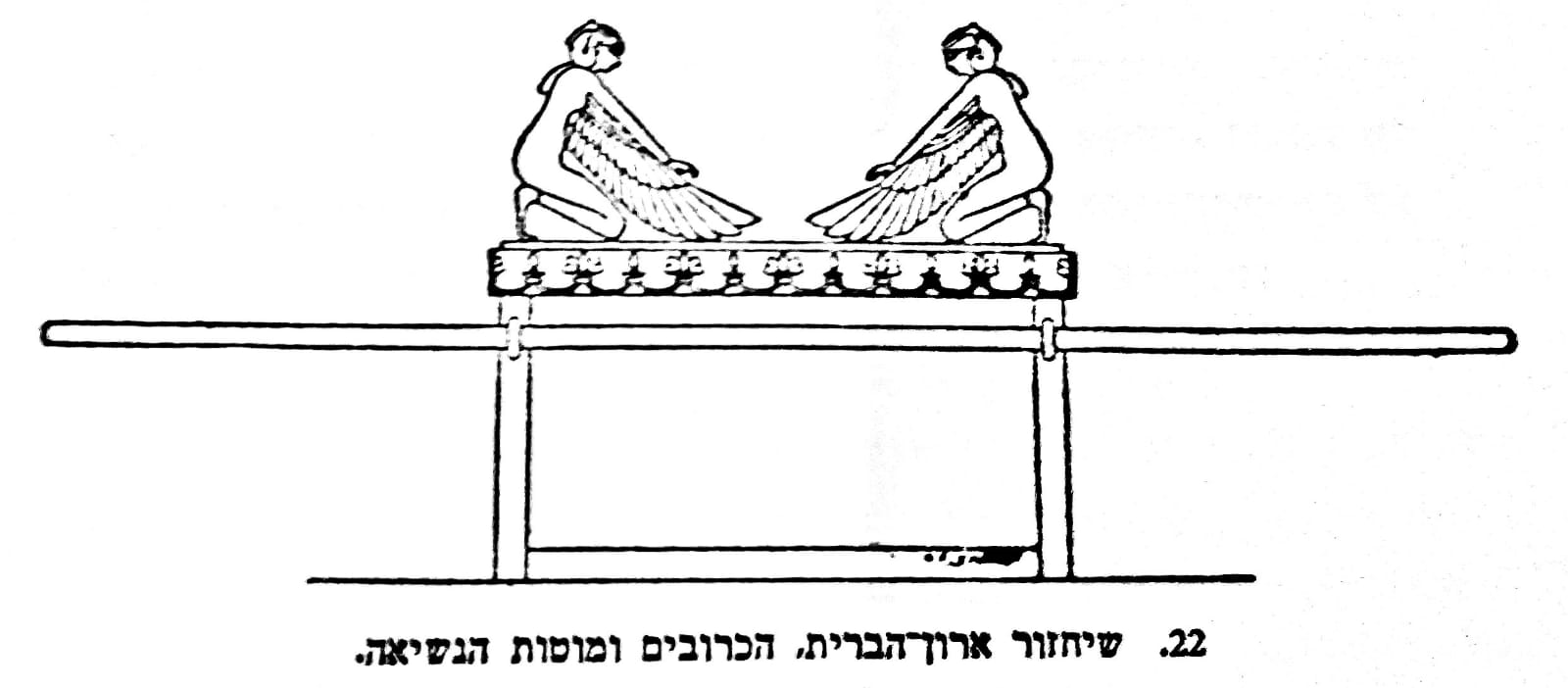
 On the first night of Rosh Hashanah 5781, a friend who shares my fascination with Tanach gave me as a gift an old copy of Werner Keller's The Bible As History translated into Hebrew. Later that night I skimmed the book. The first page that opened up had the following picture on the bottom: For some reason, I was captivated (and I knew the book was definitely a keeper, if for nothing else but having access to this picture :)). I still can't quite explain why it interests me so much. Some about how it never occurred to me that the styling of the Ark could be Egyptian  of all things. Don't get me wrong, I think Egyptian wings are awesome, but there's always a feeling that if the Mishkan was merely a copy & paste of a classical Egyptian temple, then what's the point? Therefore, it was a head-scratcher for a couple of weeks: Who would draw an Egyptian-style Ark and why? Nobody is credited in the book, at least not in my edition. Finally, earlier this evening, I goog...