Posts

Showing posts with the label places

A Hint of Qumran in a Targum?

Fourty years ago, Steven Bowman published an article discussing the possibly meaning of the name of Khirbet Qumran, which gave its name to the famous scrolls found in its vicinity. In the article he raised the likelihood of the word 'qumran' having Syriac-Aramaic origins and coming from the word 'Kumri(a)' (כומרי, כומריא), which means 'priest(s)' (although in Hebrew this root is usually associated with priests of idolatrous religions, and at some point after the rise of Christianity became the common word for Christian priests, Komer (כומר)). He suggested connecting this with a commonly-accepted notion (although I have some doubts) that the ancient Qumran sect(s) was(/were?) a group of priests or had an association with a priestly sect. The exact identification of the ancient settlement that was located at Qumran is debated. Many have suggested Tanachic Sechachah (סככה), others have suggested Tanachic Ir Ha'melach (עיר המלח) as Iron Age remnants were found...

Ham

Image
 No, not that kind of Ham. In Parashat Derachim, pg. 338-339, Dr. Yitzchak Meitlis brings a view that the word "chavoteihem" (חותיהם), a group of settlements captured by Yair ben Menashe ( Bamidbar 32:41 ), is a combination of the words "Chavot" and "Ham"; Ham being a place mentioned in the conquest of the Four Kings ( Beresheet 14:5 ), or in other words, "chavoteihem" means "the villages of Ham". I thought that was a fascinating idea, particularly because that area was in Amorite territory. Why is that important? Because in Canaan there was an Amorite king named Hoham (הוהם) ( Yehoshua 10:3-5 ). As far as I know, not much is known about the Amorite language, but I'm guessing there's a connection between Hoham and Ham. Perhaps his name means something along the lines of "man of Ham" or "son of Ham", or something like that. Meanwhile, Obelix has discovered he enjoys gefilte fish. (images taken from Asterix an...

A hint of Kemet in Tanach?

Image
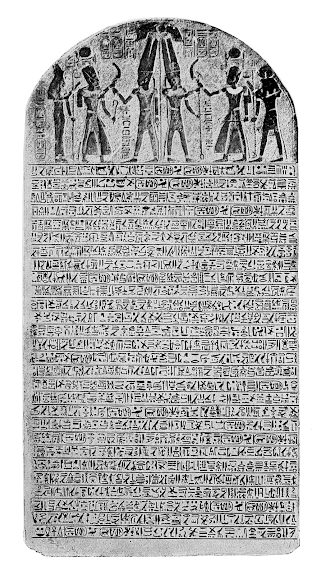
 According to Wikipedia , the Egyptian name for Egypt was not Mitzrayim (*gasp*) nor even Egypt (which is Greek *double gasp*) but Kemet , which is apparently Egyptian (or Kemetian?) for "black land" (something about the richness of Nile soil). One could sort of twist that to form the name Cham - חם, who was of course the father of Mitzrayim. With that said, I noticed something interesting today in the Book of Yehoshua: It is well-known that until not long before Am Yisrael came to Eretz Yisrael, the Egyptian maintained here a strong presence. Many Egyptian artifacts have been found in digs all around Israel. However, to my knowledge and understandings, their presence here was hardly ever reflected in place-names. Rabbi Ahron Marcus in his essay "Of The Jewish Chronology" mentions in a footnote Citri's (not sure who he was) view that the name Ma'ayan Mei Nafto'ach - מעין מי נפתוח ( Yehoshua 15:9 and 18:15 ) comes from Merneptah and that his real name wa...