Posts

Showing posts with the label kings

Even Izevel had some Good in Her

I just came across this wonderous midrash. The midrash came to explain why Izevel (Jezebel)'s skull, feet and palms remained after her corpse was devoured by dogs ( Melachim 2:9:35 ). According to the midrash, which appears in multiple sources, including Pirkei De'Rabbi Eliezer and Yalkut Shimoni , "Whence do we learn (the duty of) showing loving-kindness to mourners? From Jezebel, the daughter of Ethbaal. The palace of Jezebel, daughter of Ethbaal, was near the market-place. When any corpse was carried through the market-place, she would go forth from her palace, and she clapped with the palms of her hands and praised with her mouth, and she followed the corpse ten steps. Concerning her, Elijah, be he remembered for good, prophesied (and said): "In the portion of Jezreel shall the dogs eat the flesh of Jezebel" (2 Kings 9:36). But over the limbs which were (employed in) showing loving-kindness, the dogs had no power, as it is said, "And they went || to bur...

Exciting News! + An article on idolatry in Kriat Yam Suf

Image
So, very exciting news that I got just a last night - I was informed by the editors of the journal Megadim that my article has been accepted for publication. They just recommended a few small corrections. Once I send in the final draft they'll start preparing it for publication, presumably for the next volume (64). Don't remember if I've shared in the past, but I can sure share now that the article suggests a new interpretation for the difficultly-phrased verse in Melachim 2:15:25: " וַיִּקְשֹׁר עָלָיו פֶּקַח בֶּן רְמַלְיָהוּ שָׁלִישׁוֹ וַיַּכֵּהוּ בְשֹׁמְרוֹן בְּאַרְמוֹן בֵּית  מלך  [הַמֶּלֶךְ] אֶת אַרְגֹּב וְאֶת הָאַרְיֵה וְעִמּוֹ חֲמִשִּׁים אִישׁ מִבְּנֵי גִלְעָדִים וַיְמִיתֵהוּ וַיִּמְלֹךְ תַּחְתָּיו." "His aide, Pekah son of Remaliah, conspired against him and struck him down in the royal palace in Samaria; with (?) Argob and the Arieh, and with him were fifty Gileadites; and he killed him and succeeded him as king. The verse describes the assassination ...

Another paper, more nerves/excitement

So, a few minutes ago I submitted another Tanach-related paper to a fairly good Israeli Tanach journal. This is not my Levitical Cities paper. I decided to take an extended break from that one to clear my head and finish my BA schoolwork. During my spare time, I focused on three projects in particular: Two Tanach papers and a midrash paper. So, the first of these papers, which was submitted today, is about a curious verse in Melachim, which Biblical Criticism scholars have (naturally) thought to be distorted. I propose in the paper two chiddushim: The first explains why the verse is not distorted and in fact can be explained easily based on a phenomenon found in colloquial Hebrew throughout the ages (yup - from Tanachic times [including epigraphic sources!!] through modern Israeli Hebrew). The second proposes a new interpretation for the verse as a whole, drawing on symbolism and comparison to many other sources. I'd love to share more, but I'd like to see this thing get throug...

Further Thoughts on Efron and Chevron

After my recent post on the titular topic, I noticed that Yehoshua 14:15 explicitly states that Chevron was originally named Kiryat Arba after Arba, father of the three main giants who lived in Chevron (Achiman, Sheshai and Talmai). That means that when Avraham was dealing with Efron in Chevron, it likely still hadn't been renamed! Which of course strengthens my suggestion that Chevron was named after Efron. I would suggest that the variant Chevron, which contains the root Chaver (חבר, friend), was chosen because it symbolized the hand of friendship that Efron had extended Avraham, and naming the city after the former was a way of showing thanks to him for that. I was also reminded of two parallels: Goren Aravnah and Shomron. Goren Aravnah or Goren A rnan (the threshing-floor of Aravnah/Arnan) was some sort of threshing compound on the top of what was to become the Temple Mount in the time of David, originally owned by a Yevusi man named Aravnah (in Shmuel) or Arnan (in Chronicl...

Ba'al Zevuv

Some time ago a friend requested my assistance in tracking down info regarding the idolatrous deity Ba'al Zevuv (Beelzebub). I believe he was interested in modern scholarship on the matter and in particular was hoping there'd be archeological data that would shed light on the mystery. So I rolled up my sleeves and got to work. Spoiler: I didn't find too much, but there are some interesting suggestions out there. Ba'al Zevuv appears in two verses in Melachim 2:1:2-3 : "Ahaziah fell through the lattice in his upper chamber at Samaria and was injured. So he sent messengers, whom he instructed: “Go inquire of Baal-zebub, the god of Ekron, whether I shall recover from this injury.” But an angel of G OD said to Elijah the Tishbite, “Go and confront the messengers of the king of Samaria and say to them, ‘Is there no God in Israel that you go to inquire of Baal-zebub, the god of Ekron?" After which Eliyahu informs Achazyah ( ibid. 4 ): "Assuredly, thus said G OD...

New Dan

A short explanation on the blog's hiatus: I have been extremely busy lately and that's why I haven't updated in a long time. I actually started making this post over a month ago. Then I had to work on other things, and this post was put on the backburner. I'll try to make a few more posts in coming weeks. I don't want this blog to die down. Some time ago, it suddenly occurred to me that we know very little about the territory of the Tribe of Dan after they moved north. We know they built the City of Dan, and...that's it... But one city can't support an entire tribe. Even the Levites, despite being a small tribe, received 48 cities. So where are all of Dan's other cities and towns? What were the borders of "New Dan"? I'm hoping to make this mapping out of their territory an on-going side-project. From what I know, we have next to no knowledge of their territory, so this will be very speculative. But I thought it would be a fun thing to try o...

The Downfall of the House of Omri

Image
As a continuation of my recent post on the rise of Omri and the special trait of his house, I noticed that this is how Yehu killed the descendants of Achav: Divide and conquer. In Kings 2:9:21-24 , Yehu approaches both King Yehoram, son of Achav and King Achazyah, son of Atlayah, daughter or sister of Achav and Yehoram, son of Yehoshafat. It may be understood from the verses that Yehu first barged towards Yehoram, cursing him, as though he did not notice Achazyah. This makes Yehoram conclude that Achazyah was betraying him and shouts at him "Treason, Achazyah!" before he is slaughtered by Yehu. Yehu then gives chase to Achazyah and slaughters him as well ( ibid. 27 ). Next he slays the 70 other sons of Achav ( ibid. 10:1-11 ). Finally, he kills the 42 kinsmen of Achazyah ( ibid. 10:13-14 ). All of this spilling of blood was appranetly caused by one man. The various branches of the House of Achav could have taken him on, but they were ill-prepared and divided (in some cases, g...

Tivni vs Omri: Separation vs Unity

A short idea I thought of now: Ephraim Ha'Reuveni was a famous Jewish botanist in Israel. In an essay he wrote on Tanachic names that come from plants and animals, he pointed out that both Omri and Tivni (as well as some other names) are plant names: Omri comes from Omer (עומר), which means 'sheaf of grain' and Tivni comes from Teven (תבן) which means 'hay' (see here , p. 388, n. 36). Now, Omri was a famous king of Israel. Before that he had been a general in the Israelite army, and when the Israelites heard that Zimri had killed King Elah and the House of Ba'asha, they followed Omri to do battle against Zimri, eventually killing him. After this had happened, a challenger rose: Tivni ben Ginat. This caused the splitting of the Israelites into two factions: Followers of Omri and followers of Tivni, as it says in Kings 1:16:12-13: "Then the people of Israel split into two factions: a part of the people followed Tibni son of Ginath to make him king, and the ot...

Anakim, Rephaim, oh my!

This week's parsha features Bnei Yisrael passing through Edom and the two Emorite countries - Sichon's country and Og's country ( Bamidbar 21:21-35 ). Og was the last of the Rephaim ( Devarim 3:11 ), a race of giants that were wiped out way back during the War of the Four and Five Kings in Beresheet ( 14:5 ). Some midrashim state that Sichon was also a giant, of the antediluvian kind (for example, Devarim Rabbah 11:10 ). Looking through Tanach it occurred to me that giants might be frightening, but they obviously aren't unbeatable. David and his men defeated a number of giants, and, as mentioned already, the four Mesopotamian kings managed to defeat the Rephaim. And yet, two parshas ago, when the spies told Bnei Yisrael that there were Anakim in the Land of Yisrael ( Bamidbar 13:28 ), Kalev and Yehoshua said nothing about "hey, guys, giants are not unbeatable!" Kalev made a more generalized statement, that "yes we can, because we have Hashem!" ( ibid...

A possible hint to Daryavesh's Judaism

I've been quite busy lately and still am. I've started a number of posts but haven't gotten around to finishing them. However, yesterday I realized something interesting while reading a book, and it's short, so I'm sharing it. So Purim has come and gone...several months ago. But when you think about it, maybe Purim should be year-round because the whole build up to the grand finale of Esther was years in the making. Anyway, Daryavesh, or Darius, the one under whom the Second Temple was completed, was, according to Jewish tradition, the son of Queen Esther and King Achashverosh (see for example Midrash Yalkut Shimoni on the Torah 536 ). However, this is never openly acknowledged in Tanach. There might be any number of reasons for this, including that we have misunderstood our sources and they are not referring to the same Daryavesh under whom the Temple was completed; that Daryavesh was so far gone from Judaism that there was no point; IT'S A THEOLOGICAL CONSPIRA...

Drush and p'shat on Achaz's name

Image
An Assyrian inscription from the time of Tiglath Pilesser III describes a list of kings that were conquered and subsequently gave tribute to the Assyrian king reads: "I installed Idi-bi'li as a Warden of Marches on the border of Musur. In all the countries which...[I received] the tribute of Kushtashpi of Commagene ( Kummu ḫ u ), Urik of Qu'e, Sibitti-be'l of Byblos,...Enil of Hamath, Panammu of Sam'al, Tarhulara of Gumgum, Sulumal of Militene,...Uassurme of Tabal, Ushhitti of Tuna, Urballa of Tuhana, Tuhamme of Ishtunda,...[Ma]tan-be'l of Arvad, Sanipu of Bit-Ammon, Salamanu of Moab,...Mitinti of Ashkelon, Jehoahaz ( Ia- ú - ḫ a-zi ) of Judah ( Ia- ú -da-a-a ) , Kaushmalaku of Edom ( Ú -du-mu-a-a ), Muzr[i...] ( Ḫ a-a-nu- ú -nu ) of Gaza ( Ḫ a-za-at-a-a ) (consisting of) gold, silver, tin, iron, antimony,4 linen garments with multicolored trimmings, garments of their native (industries) (being made of) dark purple wool...all kinds of costly objects be they pr...

Tanach: The Beginner's Guide to Being a Prophet

A couple of days ago I read a great essay by Yairah Amit . Amit argued that the story of Shmuel's becoming a prophet as described in Shmuel 1:3:1-21  reflects matters of interest and comes to answer subjects that were debated in the circles of the prophets of Yisrael. In short: Prophets were rare in the time of the judges. People generally turned to the kohanim (priests) for guidance. The story is designed in a way that shows the divine providence leaving the kohanim and passing over to the prophets. Prophecy was individualistic, i.e., only the prophet could hear Hashem talking to him. In another essay I saw today by Chaim Gevaryahu, he argued (based on similar prior suggestions) that most prophets of the early days made a living off of donations from people who came to them, or they wandered from town to town and city to city collecting donations. This can be seen in several instances in Tanach, including by Eliyahu, Elisha, Shmuel, Achiyah Hashiloni and more. Now, about a year ag...

Eulogizing in Tanach

Image
לעילוי נשמת אברהם בן ישראל יצחק Post in memory of Avraham ben Yisrael Yitzchak Last night, my grandmother's brother died. This comes in the wake of the passing of my grandfather less than two years ago and the passing of one of my aunts less than a year ago. All very sudden and health-related, but nothing due to corona. This post is dedicated in his memory. Some time ago, I noticed that there was a typical sort of eulogy or lament in Tanach. It is referred as "הוי אחי" - "Oh, my brother". It's only mentioned twice in Tanach - in Kings and Yirmiyahu, but there's also a sort of - offshoot, I guess? that appears later in Yirmiyahu as well, which is a eulogy that seems to have been reserved for royalty, and that's the "הוי אדון" - "Oh, [my] lord" eulogy. Here are the verses (this translation uses the variants "alas" and "ah" instead of "oh"): "He laid the corpse in his own burial place; and they lame...

Conspiracy theory: The modern Samaritans have preserved ancient Assyrian customs

Image
Long time no see guys. In-between balancing school and homework, ideas for posts have been little to practically non-existent. But earlier this week I finally thought up of something that is blog-worthy, in my humble opinion (and since I run this blog, that humble opinion is what goes around here... ;)) The first word in the post's title was not really my choice: Last night I told over my new idea to a friend from university and he said: "Hmm. Interesting conspiracy theory..." Personally, I would have gone just with "theory", and I told him that. He proceeded to explain why he thought it was a conspiracy theory, but let's not get into that (he also believes it's wrong to term "Biblical archeology" with any word that has anything to do with the Tanach, AKA the Bible...we won't get into that either today). About a month ago, the archeology department had a field trip to Mt. Gerizzim, and after that we went to meet some of the leaders of the S...

Re-examining anti-Shaulian tendencies in Chronicles

Image
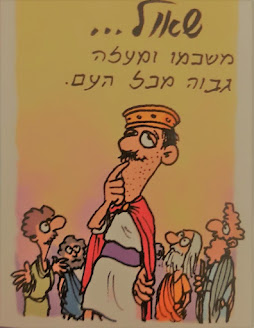
  (Image from Shay Charka 's נגיד שבבא בתנ"ך (highly recommended)) Ask just about any bible academic, and they'll tell you that whoever authored Chronicles was basically writing pro-Davidic propaganda. Okay, pro-Davidic-- as opposed to what? Pro-Shaulian, of course. That's right, Am Yisrael's first official king (setting aside whatever halachic status Moshe may have held, and also, l'havdil, setting aside Avimelech, son of Gidon), King Shaul, while mentioned in Chronicles, doesn't get that much limelight, certainly nowhere close to that of David (David's kingdom covers almost all of Chronicles 1, and most of Chronicles 2 is dedicated to his descendants' stories). Bible critics are quick to notice this, and generally deduce that this means that the author of Chronicles was anti-Shaul and pro-Davidic, and did everything in his power to reduce Shaul's role in the history of Am Yisrael. Now me, I believe in our sages' tradition that Chronicles ...

People-specific prophecies

Image
(image by Gustave  Doré, taken from here ) It is well known that biblical critics are immensely bothered by the Book of Yesha'ayahu. The reason that they are bothered by it is not  because it's, as they claim, made up of two to fifty (roughly) different books of different prophets, of whom only one is named (Yesha'ayhu I), but really because they deny the very possibility of prophecy. To them, prophets were the ancient world's equivalent of thinkers and political advisors. No spiritual capabilities whatsoever. As long as the prophets gave generalized apocalyptic "prophecies" that could mean anything and may not even come true, the prophets were in the clear. No, what really bothers critics is when prophets got something right . Then the prophet is a goner: He or she will be pushed from their classically-accepted era to the future, a time in which everyone  knew what had transpired, thus removing any real prophetic abilities from them. But what really bothers c...

Rabbi Tanchum Hayerushalmi on the Sons of Tzaddok

Image
In Yechezkel it's stated a number of times that the only branch of kohanim that remained loyal to Hashem were the sons of Tzaddok. It has been interpreted by some to mean that from that point on, only the sons of Tzaddok can be Kohanim Gedolim (High Priests). The cult in the Dead Sea were big fans of the sons of Tzaddok, and apparently were very much against the House of Chashmonai for taking the High Priesthood for themselves, apparently stealing the sons of Tzaddok's right to the post. So who was Tzaddok? Most believe that Tzaddok refers to the KG in the time of Shlomo. After the KG Evyatar sided with Adoniyah, Shlomo fired him and sent him to Anatot ( Melachim 1:2:26-27 ), and Tzaddok stepped in his stead ( ibid. 35 ). Another option is Tzaddok II, a descendant of the first ( Divrei Hayamim 1:5:38 ). A third option was suggested by Rabbi Tanchum Hayerushalmi in his commentary on Chaggai 1:1: "עם אותו יהושע בן יהוצדק הכהן, מפני שהוא יורש הכהונה, שהרי יהוצדק אביו היה כהן ...

And the strayed who are in the land of Assyria

 After finishing Divrei Hayamim for the first time (and going through certain chapters several more times after that), I sat back and realized that of all of the tens and hundreds of thousands of people from the two and a half tribes from ever haYarden, we only have a handful of names. We have tribal leaders from the time of the desert, we have some later shoftim and assistants of David and Shlomo, we have a speculated king from Gad (Menachem) and we have some tribal leaders from other generations. That's about it. It comes down to maybe 100 names. Two and a half tribes cut down to about ten minyans. That's sad. After comparing the list to that of Judea - Yehudah, Levi and Binyamin - I thought, man, why don't we have a Chronicles version for the 10 Lost Tribes? But that's actually not true. We had  one, or at least commonly believed to have had one. But like the Lost Tribes, it got lost. It's only ever mentioned in the Tanach, not actually inserted into it. It was c...