Posts

The Girgeshites

Long time no see... Life has been incredibly busy and is still a bit busy, but at least I have time for making a post on occasion. Here's an interesting thought about the Girgeshites. The Girgeshites (הגרגשי) were one of the seven Canaanite nations. According to Yerushalmi Sheviit 6:1 : "For Rebbi Samuel bar Naḥman said, Joshua sent three orders to the Land of Israel before they entered the Land: Those who want to evacuate should evacuate, those who want to make peace should make peace, those who want to go to war should go to war. The Girgasites evacuated, believed in the Holy One, praised be He, and went to Africa." Famously, Procopius also brought a version of this tradition in his work The History of Wars, IV : " In that country there dwelt very populous tribes, the Gergesites and the Jebusites and some others with other names by which they are called in the history of the Hebrews.  Now when these nations saw that the invading general was an irresistible prodigy...

Academic publication of the Mt. Ebal amulet

Prof. Gershon Galil et al have finally published the long-awaited academic publication of the Mt. Ebal amulet . Galil received a lot of heated backlash from the academic world when he first announced last year his reading of the amulet, found during sifting work of the backfill from the 80's excavation of the Mt. Ebal altar in Samaria. Galil hadn't gone through the more acceptable procedure of publishing his research through a peer-reviewed platform. Peer-reviewing has its flaws, but it's also a useful tool for gauging the legitimacy of a person's research. I thought at the time that he must have a good reason for this unorthodox action, and decided to give him the benefit of the doubt. Not long afterwards he announced the discovery of a similar "curse" inscription, dated to Jebusite/Canaanite Yerushalayim. Once again, nothing on when a peer-reviewed publication will come out. And then he announced the discovery of a series of inscriptions which he associated ...

The Blasphemer - It's Complicated

I considered writing another post about the blasphemer, a subject near and dear to my heart (because it's an unsolved mystery!), but then I discovered to my shock that my last post on the subject was actually still in draft mode, never published..! So, though I'm still super busy, here's a ready-made post from last year, touched up and completed: The blasphemer is a subject that has been on and off of my mind for a couple of years now. The blasphemer was the son of Shlomit bat Divri, a woman of the Tribe of Dan, and an Egyptian man, who lived during the time of the Exodus. He had an argument with a purely-Israelite man and ended up cursing God, hence his title as "the blasphemer". He was put to death. The midrash ( Sifra 14:1 ) attempts to explain this story thus: "("And the son of an Israelite woman went out; and he was the son of an Egyptian man in the midst of the children of Israel. And they strove within the camp, the son of the Israelite woman and ...

Where I'm At...

 AKA, why hasn't there been a post in nearly a month. Well, I've been incredibly busy and I'm still incredibly busy. And I haven't really had something to post. I'm back on the media team for the second season of excavations at Tel Tibneh, and I'm designing the new logo, plus working on a few other things. My dream is create an artistic reconstruction of one of the areas of the site, but I don't know if I have enough coloring experience for that. I was been cramming instruction videos for the last week or so, plus putting in some sketchbook practice, something I haven't done seriously in...years... Other stuff: I was sick for a few days this past week. I've been working on a paper I would like to try to publish. Not the one that was mentioned here in previous posts. That's on hiatus due to reasons not in my control. This is other paper is what one of my professors would refer to as "P.I." (post-interesting). It actually interests me a l...

Pre-Islamic Arabian Dust Worship

One of my interests is researching idolatrous practices mentioned in Tanach and later Jewish sources. For the last three years or so, I've been conducting an on-and-off search for the possible identity of a deity hinted at in this section of the Talmud, tractate  Bava Metzia 86b : "The Gemara continues its analysis of the verse: “Let now a little water be fetched and wash your feet” ( Genesis 18:4 ). Rabbi Yannai, son of Rabbi Yishmael, said that the guests said to Abraham: Are you suspicious that we are  Arabs who bow to the dust of their feet ?" It is reasonable to conclude that the sages were aware of an Arabian pagan cult that practiced some form of dust worship. Last year I discovered that one of my professors shares this interest in researching idolatry and even wrote his doctorate on idol worship mentioned in Talmudic literature, although he was focused on particular pagan religions (Greece, Rome, and a couple of others) and didn't analyze this quote. But I did...

Yehoshua bin Nun's name

Image
Just a quick tidbit I came across now: A Late Antiquity silver lamella (an amulet text inscribed on a sheet of metal, often silver or gold) in Hebrew, Wolfe NA 3, includes the following quote: "ועמהם שבעת המלאכים שיאצאו עם יהושע בנון מחוץ למחנה..." "And with them the seven angels that exited with Yehoshua Binun the encampment..." According to Ohad Abudraham, who published the lamella in the essay ''Joshua Son of Nun and the Seven Angels': a Hebrew lamella from the Wolfe Collection', Journal of Jewish Studies  72 (2021), pp. 45-58, this type of spelling may be the rationale behind Ramban's explanation for why Yehoshua was called b i n Nun instead of b e n Nun. Ramban wrote that it was because the word "binun" (בינון) was a nickname, referring to his tevunah (תבונה), his wisdom. So, we have here evidence of Jews of Antiquity seemingly agreeing with Ramban's idea. Perhaps they did not think up of an explanation themselves but simply c...

Shushan Purim Isru Chag Post

Image
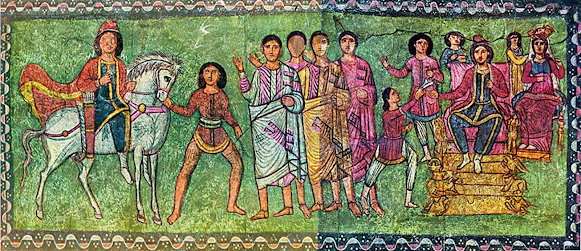
I was going to post this yesterday, but I'm swamped with work...let's just call this the Shushan Purim Isru Chag post...😁 For those who don't know, Dura Europos, a city in eastern Syria, was excavated in the 1930's. One of the most incredible discoveries made there was a well-preserved shul . The shul's walls were decorated with beautiful paintings of scenes from Tanach, such as Eliyahu at Mt. Carmel, the Plishtim being punished for taking the Ark, King David, the First Temple and so forth. One of the most fascinating things about these paintings - which are dated to the years 244-245 CE - is that some of them are based on midrashim. For example, the Eliyahu at Mt. Carmel painting clearly shows Chiel Beit Ha'eli hiding in the Baalic altar and being killed by a snake (alluded to in  Shemot Rabbah 15:16  and  Pesikta Rabbati 4 ; stated explicitly in  Yalkut Shimoni on Nach 214 ). With regards to Purim, there's an honest-to-goodness Purim panel at that shul: ...