Posts

An interesting idea on Noach's fig saplings

This is an interesting idea I came across some time last year: In Beresheet Rabbah 36:3 it says: "Instead " To plant a vineyard "; from where did he acquire it? Rabbi Abba son of Kahana said: "He gathered to him planting vine shoots and saplings of figs, and cuttings of olives" The grapevine were taken to make wine, and it seems to me pretty obvious that Noach wanted to drown out his sorrows with wine, and knew he would need this ahead of time. But why fig saplings? Rabbi Yishai Zargeri wrote in his book Bigdei Yesha (בגדי ישע), pp . 67-68 (my translation): "And it seems to me that the explanation is that we find that Noach prepared sacrifices when he exited the ark, and to light the fire he needed wood, and since all of the trees were soaked with water it wasn't relevant to light the fire from them, and so Noach needed to bring with him trees into the ark. And it says in the mishna in masechet Tamid ( p. 29a ) that wood from all the trees were fit fo...

Tivni vs Omri: Separation vs Unity

A short idea I thought of now: Ephraim Ha'Reuveni was a famous Jewish botanist in Israel. In an essay he wrote on Tanachic names that come from plants and animals, he pointed out that both Omri and Tivni (as well as some other names) are plant names: Omri comes from Omer (עומר), which means 'sheaf of grain' and Tivni comes from Teven (תבן) which means 'hay' (see here , p. 388, n. 36). Now, Omri was a famous king of Israel. Before that he had been a general in the Israelite army, and when the Israelites heard that Zimri had killed King Elah and the House of Ba'asha, they followed Omri to do battle against Zimri, eventually killing him. After this had happened, a challenger rose: Tivni ben Ginat. This caused the splitting of the Israelites into two factions: Followers of Omri and followers of Tivni, as it says in Kings 1:16:12-13: "Then the people of Israel split into two factions: a part of the people followed Tibni son of Ginath to make him king, and the ot...

The hidden meaning of Arvanah's name

Image
Shanah Tovah to everyone and have an easy fast. A quick realization that I came to shortly before Mincha yesterday: In Shmuel 2:24:18 , David was commanded to build an altar in a place in Yerushalayim called 'Goren Arvanah ha'Yevusi (The Threshing Floor of Araunah the Jebusite)'. Since it was owned by Arvanah, David it bought it from him and built the altar. This story is also recounted in greater detail in Chronicles 1:21:18-28 . Here Arvanah is called 'Ornan'. Subsequently , David decides that the Temple should be built there, and that project was completed by his son Shlomo ( ibid. 2:3:1 ). In other words, this place would become the final dwelling place of the Ark of the Covenant. Now here's what's really fascinating: The name Arvanah, as it's spelled in Shmuel - ארונה - is made up of the word ארון and the letter ה = the word 'Ark' and the letter Heh, one of the letters of the name of Hashem. I.e., the name Arvanah equals Aron H' ('אר...

Some info on what we found in Tibneh

Image
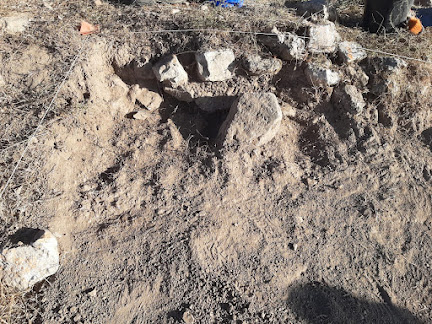
As promised, a post on why I was unable to find time to make the second part of the Shiloh destruction posts for over a month. It was because, as previously mentioned here , I had gone on a month-long excavation in Tel Tibnah/Tibna/Tibneh (however you want to spell), an archeological tel in Southwest Shomron (Samaria). We were quite busy there and between the archeological work and my work as a volunteer translator of our social media posts, as well as occasional breaks, I couldn't find the time to make the post. I thought I would use the following post to discuss some of the Tanachic-era findings from the site. Not everything has been properly studied yet, though, so there's not that much to say right now. The site is identified by pretty much all scholars with the Roman-era regional capital city Timnah. Some scholars also identify it with Timnat Serach or Timnah Cheres, the city of Yehoshua bin Nun. During this first season of excavations, we mostly found Roman and Hellenisti...

Irad, Iram and other Ir names

Been a little while since I've made a post on name-meanings, but I had this realization recently. For some time this last semester, I had been looking into the topic of apocryphal Enochic literature, because I had been thinking about doing a project on it for one of my courses. Eventually I switched to a different topic (if you're curious, it's about the Nesiut (patriarchy) of Rabban Yochanan ben Zakkai) , but having already delved pretty deeply into the subject, I realized recently that the topic might serve to explain the meaning of two ancient Tanachic names. I say ancient because chronologically-speaking, these people are some of the oldest in Tanach. Irad: Irad was none other than Kayin (Cain)'s grandson, son of his son Chanoch (the first, less-famous Enoch): "וַיִּוָּלֵד לַחֲנוֹךְ אֶת  עִירָד   וְעִירָד  יָלַד אֶת מְחוּיָאֵל וּמְחִיָּיאֵל יָלַד אֶת מְתוּשָׁאֵל וּמְתוּשָׁאֵל יָלַד אֶת לָמֶךְ." "To Enoch was born Irad, and Irad begot Mehujael, and Meh...

The Destruction of Shiloh, Pt. 2

So, life got in the way (more on that in a future post) and I was not able to create the second post until now. Apologies to anyone who may have been waiting. To recap, the destruction of Shiloh and the apparent subsequent removal of the Tabernacle from there are never explicitly mentioned in the Book of Shmuel. We only have some later hints to this in Yirmiyahu and Tehillim. That question is: This seems to have been a moment of great tragedy to Am Yisrael, according to the two instances in which the event is hinted at. Why then was this not recounted explicitly? Last time I offered my own idea. This time I'll offer up an idea by Rabbi Eitan Shandorfi in his book "הדר הנביאים" - "Hadar Ha'Nevi'im" (the Splendor of the Prophets). Rabbi Shandorfi dedicated an entire chapter of his book to discussing the matter. He finally concluded that the primary purpose of the Tabernacle was to serve as a dwelling for the Holy Ark of the Covenant. No Ark in the Tabernac...

The Destruction of Shiloh, Pt. 1

Image
This will be a two-post series on the subject of the destruction of Shiloh. More precisely, on the destruction of the Tabernacle at Shiloh. The Tabernacle at Shiloh was constructed already in the days of Yehoshua ( idem. 18:1 ). There it remained until mysteriously disappearing circa the Israelite-Plishtite War in Shmuel 1:4:1-22 . After this war, we do not hear of people coming to the Tabernacle at Shiloh. Instead they go to places such as Nov and Giv'on. The reason was only reported centuries later, in Yirmiyahu 26:1-6  where Hashem tells Yirmiyahu to pass on a prophecy that if the people of the Kingdom of Yehudah do not fix their ways, the Temple will be destroyed just like the Tabernacle in Shiloh (similarly mentioned in ibid. 7:13-15 ). Subsequently, people get angry at Yirmiyahu for having the gall to threaten them with a destruction on par of that of Shiloh ( ibid. 8-9 ). Wait, destroyed? When did that happen?! Actually, this was hinted at already in a Tehillim chapter writt...